Last updated November 17, 2026




Free written scope consultation - allowances, timeline, and change-order rules on paper before a single trade is scheduled
How Long Does Driveway & Pavers Take? Timelines and What to Expect
Miami-Dade’s Building Department typically takes 15 to 30 business days to review a residential driveway permit. That single fact reshapes every schedule you’ll hear this year. A contractor who promises to break ground two weeks from signing either hasn’t filed yet or is guessing. In our experience, the honest answer to how long driveway pavers take in Homestead runs six to twelve weeks from signed contract to final inspection, and the paver crew’s actual work occupies less than a third of that window. This guide breaks the timeline into phases, with day counts, so you can read a schedule document and know whether it’s real.
Quick Answer
A typical driveway paver project in Homestead takes six to twelve weeks from contract to final sign-off. Permit application and Miami-Dade review alone account for 15 to 30 business days, material lead time adds three days to six weeks depending on the product, and the physical installation of a standard two-car driveway (roughly 500 to 700 square feet) runs three to five working days if the weather cooperates. Weather rarely cooperates between May and October.
Styles & brands we work with
- Kitchen remodeling
- Bathroom remodeling
- Home additions & ADU
- Roofing
- Windows & doors
- Driveway & pavers
- Fence
Table of Contents
- Phase-by-Phase Timeline: Day Counts for Every Stage
- Why Permit Review at Miami-Dade DPRD Sets the Pace
- Material Lead Times by Product Type
- The Rainfall Window: How Afternoon Storms Add 20 – 40% to Installation Days
- Substantial Completion vs. Final Inspection Sign-Off
- How to Read a Contractor’s Project Schedule
- Legitimate Delays vs. Poor Project Management
- When Pavers Are Part of a Bigger Project
Phase-by-Phase Timeline: Day Counts for Every Stage
Every driveway paver project we quote at Rowan Construction Group Homestead follows the same five phases. The day counts below are what we build into a written schedule. They are not estimates of crew effort; they are calendar days, and they include the waits most homeowners forget to budget.
- Permit application (1 – 3 business days). We assemble the site plan, survey, and product specifications and file with Miami-Dade’s Department of Permitting, Resources and Drainage. A complete submittal on day one accelerates everything downstream. An incomplete one resets the clock.
- Permit review (15 – 30 business days). The county’s standard review cycle for a residential driveway alteration. Plan review comments can extend this by one additional cycle, which is why we read the submittal against the county checklist twice before filing.
- Material delivery (3 days to 6 weeks). Stock concrete pavers from a regional distributor typically arrive in three to five business days. Imported travertine runs three to six weeks because it ships from overseas and clears customs at the Port of Miami. Belgard and Techo-Bloc products sit somewhere in the middle depending on the profile and color.
- Base prep (1 – 2 days per 500 sq ft). Demolition of the old surface, excavation to depth, subgrade compaction, and installation of crushed aggregate base. This is where Florida’s high water table sometimes forces a surprise: saturated subgrade needs to dry before compaction, adding a day or two.
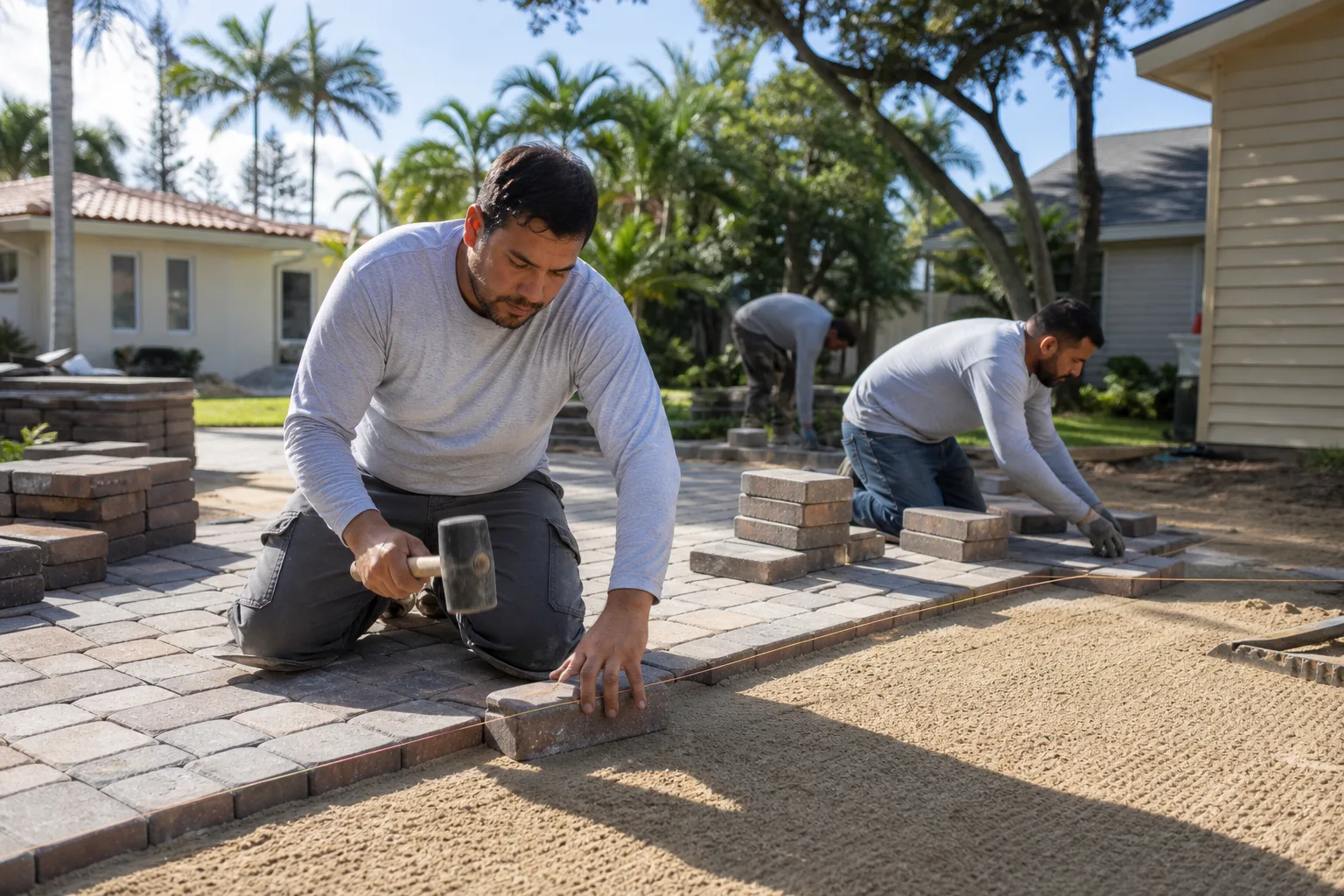
- Paver setting (1 – 2 days per 500 sq ft). Setting bed, paver layout, edge restraints, and cuts at the apron and garage threshold. Then polymeric sand joints, compaction, and a curing period of 48 to 72 hours before any vehicle weight touches the surface.
Add those up and the arithmetic says it plainly: the crew is on site for maybe four days on a 600-square-foot driveway. The calendar tells the real story.
Why Permit Review at Miami-Dade DPRD Sets the Pace
Miami-Dade County reviews every residential driveway permit at the Department of Permitting, Resources and Drainage, and the standard cycle runs 15 to 30 business days before the first reviewer even opens the file. In the busiest months, typically right after a storm event triggers a surge of repair filings, that window drifts toward the ceiling. For a Homestead homeowner, this means the schedule is anchored to a review queue you cannot speed up by paying a crew to work weekends.
What you can control is the quality of the submittal. We’ve watched projects lose two weeks because a survey number was transposed on the site plan. In Homestead, where many properties sit on county-regulated drainage swales, the plan also has to show how the new impervious surface manages stormwater runoff. Pavers installed over an aggregate base hold an advantage here: water infiltrates through the joints instead of sheeting into the swale, and that detail can simplify review. If you want to see how this plays out in the field, our overview of Driveway & Pavers in Homestead describes the products and drainage configurations we typically specify.
Two things we tell every client before signing: request a copy of the permit application receipt the day it’s filed, and check the county’s online permit portal yourself. If your contractor can’t produce the receipt, the clock hasn’t started.
Material Lead Times by Product Type
Material lead time is the variable most contractors gloss over, because it’s often outside their control. The honest version is a table, not a promise. The lead times below are what we see from regional distributors serving South Miami-Dade.
- Stock concrete pavers (Belgard, Techo-Bloc standard profiles): 3 – 5 business days from a regional distributor. The fastest category, but colors and profiles rotate through inventory, so “stock” isn’t a promise until the order is confirmed.
- Premium or specialty concrete: 1 – 2 weeks if the profile is in a regional yard, longer if it ships from the manufacturer.
- Clay brick pavers: 2 – 3 weeks, longer for specific color blends sourced from out of state.
- Imported travertine and natural stone: 3 – 6 weeks. Travertine ships from Turkey or Mexico, clears customs at the Port of Miami, and then moves to a local yard. Customs delays are the wild card and cannot be scheduled away.
- Permeable pavers (for swale-adjacent properties): 1 – 2 weeks depending on the system and whether the manufacturer supplies the required open-graded aggregate locally.
We order materials the same week the permit is filed when the product is a confirmed stock item, so the two clocks run in parallel. That’s how a six-week project becomes six weeks instead of eight. If a client falls in love with an imported travertine that has a six-week lead time, we say so on the schedule in writing, not after they’ve written the deposit. Under Clause 1 of the Haven Standard, the price and the scope are written before any work starts, and that includes a dated material delivery estimate.
The Rainfall Window: How Afternoon Storms Add 20 – 40% to Installation Days
From May through October, Homestead gets an afternoon thunderstorm on a typical day. We’ve measured this against our own project logs: pavers installed in the wet season take 20 to 40 percent more installation days than the same square footage installed November through April. That isn’t a crew problem. It’s a physics problem. Paver base cannot be compacted to spec while saturated, and the setting bed cannot be screeded in standing water.
Rain doesn’t just cost the day it falls. It costs the drying day after. A heavy afternoon storm on Tuesday can leave the subgrade too wet to compact on Wednesday morning, which pushes the whole sequence. A contractor who schedules around the pattern does three things differently:
- Builds weather days into the schedule upfront rather than treating them as surprises.
- Front-loads base prep in the morning and schedules setting work for the early part of the day.
- Keeps a sump pump and a portable covered staging area on site for a driveway that holds standing water.
The dry season runs November through April, and it’s no accident that’s when Homeowners in Homestead most often book. If your project has to happen in summer, ask any contractor you interview how many weather days they’ve written into the schedule. If the number is zero, the schedule was written for a different climate. A Fence Installation in Homestead project runs into the same rainy-season arithmetic, and experienced contractors plan for it the same way.
Substantial Completion vs. Final Inspection Sign-Off
Substantial completion is the day the pavers are set, sanded, compacted, and the crew has packed up. Final inspection sign-off is the day the county inspector signs the permit card. These are not the same day, and the gap between them is typically one to two weeks in Homestead depending on county inspection scheduling.
Why it matters: in most jurisdictions you can drive on the surface after final compaction and the 48-to-72-hour cure, but the project isn’t closed until inspection passes. A paver driveway that fails inspection because the apron is a fraction of an inch off spec has to be corrected and re-inspected, which resets the clock. We build the inspection into the schedule as its own line item, and we photograph the finished surface against the site plan before the inspector arrives. Under Clause 1 of the Haven Standard, that photo record is a standard deliverable, not an add-on, and it’s the document you want in hand if the inspector has a question.
Ask any contractor you interview for the standard inspection turnaround at their last three projects. The person who can answer with a date range has managed enough projects to know. The person who says “a few days” has not.
How to Read a Contractor’s Project Schedule
A written schedule is a test of how a contractor manages time, and most schedules fail it. Here is what a schedule document should contain, in order of importance. If yours has all five, you’re being managed. If it has none, you’re being reassured.
- Named phases with calendar day ranges. “Permit review: 15 – 30 business days” is a schedule. “Roughly three weeks” is a shrug.
- Dependencies called out. The schedule should state that setting work cannot begin until the base passes compaction and the permit is issued, not imply the crew will figure it out.
- Material order confirmation date. A schedule that doesn’t name the product or a delivery window hasn’t been built from the actual order.
- Weather contingency days. In Homestead, the wet-season schedule should include named weather days.
- The inspection line. Final inspection sign-off should appear as a scheduled milestone, not a footnote.
You don’t need a Gantt chart to satisfy these requirements. A milestone list with dates works fine. What you can’t accept is a vague promise, because a vague promise tells you the contractor hasn’t modeled the project. Ask for the schedule in writing before you sign anything. Rowan Construction Group Homestead delivers a flat written price and a written scope before work begins, because a signed number is the only schedule worth holding someone to.
Legitimate Delays vs. Poor Project Management
Some delays are honest and some are a signal. Here’s the line we draw. Legitimate delays live in the contract as named contingencies: force majeure, permitting agency delays, supplier backorders, and unexpected site conditions like buried utilities or a subgrade that won’t compact. A well-drafted contract names those and says what happens – date extension, communication, cost responsibility – when one triggers.
Delays that signal poor management look different. A crew that doesn’t show up on the scheduled day without a call. A material delay nobody told you about until the pavers didn’t arrive. A schedule that changes without a written revision. “We should have the permit next week” for six weeks running with no receipt to prove it. In our experience, the leading indicator is communication: a contractor who tells you about a two-day weather slip the morning it happens is managing the project; a contractor who goes quiet and reappears three weeks later is not.
One documentation habit worth adopting: keep every schedule revision in one place. When the final walkthrough happens, you should be able to see exactly how many days the project drifted and why. Under the Haven Standard’s change-order discipline, no schedule change that adds cost proceeds without a signed change order, and the customer should be able to see what changed and when.
When Pavers Are Part of a Bigger Project
Driveway paver installation sometimes runs alongside other work – a new patio at the same time, or a larger site project that includes a home addition or ADU where the driveway is the access route. This is common enough on rural Homestead properties with acreage that we plan for it. When pavers are part of a larger scope, the driveway schedule is constrained by the other project’s phases, not the paver crew’s. If you’re considering a bigger renovation, our overview of Home Additions & ADU in Homestead is a useful parallel read. Structural work affects site access, staging, and sometimes the drainage plan for the whole lot.
We’ve also seen prefab and modular projects enter the mix. A modern prefab home – names like Boxabl, Cover, and Mighty Buildings come up in this conversation – arrives on a flatbed with a delivery window measured in hours. If the driveway needs to be paved before the home arrives, the permit review cycle is often the fixed constraint. We sequence the paver schedule so the surface is compacted and cured before delivery day, and we build a contingency week around the manufacturing delivery date so a one-week factory slip doesn’t strand a finished site. That’s what a written schedule is for. The rest is what a written schedule protects you from.
Common Mistakes to Avoid
- Signing before the permit is filed. If the contractor can’t show you the permit application receipt, the 15-to-30-business-day review clock hasn’t started yet, and every week you wait adds a week to the calendar.
- Ordering imported stone without confirming the customs schedule. A six-week travertine lead time can become eight if the container is held at the Port of Miami, and no contractor controls that. If your schedule is tight, stay with stock concrete.
- Scheduling installation for August because the crew is available. Crew availability isn’t the constraint; the wet season is. The 20-to-40-percent weather penalty is real, and fall weather in Homestead is the good weather.
- Accepting a vague start date as a schedule. “We should get started in a few weeks” isn’t a schedule; it’s a hope. Ask for the milestone list in writing before you sign.
- Assuming the project ends when the pavers are set. Final inspection sign-off can add one to two weeks. Build that gap into any move-in or landscaping plan.
- Not confirming the drainage plan for swale-adjacent lots. Miami-Dade examines stormwater runoff on driveways, and a plan that ignores the swale can trigger a plan-review comment and a full additional review cycle.
- Skipping the Free Second Opinion on a competitor’s written estimate. Bring us any quote and we’ll review it line by line at no charge. Reading two schedules side by side is the fastest way to spot a contractor who hasn’t modeled the project.
See the difference
 Before
 After
 Before
 After
 Before
 After
When to Call a Professional
Call us when you’re comparing schedules and want a second set of eyes on what a contractor has promised. Call us when your permit has been filed and the review has sat longer than 30 business days; we can check the submittal for a missing item. Call us when a paver project is part of a larger scope – a new patio, a home addition, or an ADU – and the schedules need sequencing. Call us when an existing paver driveway from a previous owner has settled, heaved, or drains badly; the diagnosis is a site visit, not a phone call. Rowan Construction Group Homestead offers free estimates in Homestead and a Free Second Opinion on any written estimate you’ve received from a competitor. Call (844) 834-4248 to schedule yours.
Frequently Asked Questions
From signed contract to final inspection, plan on six to twelve weeks. The physical installation of a standard 500-to-700-square-foot driveway takes three to five working days; the rest of the calendar is permit review (15 – 30 business days), material lead time (three days to six weeks depending on product), curing (48 – 72 hours), and final inspection scheduling (one to two weeks). Call (844) 834-4248 for a written schedule tied to your specific address.
Because the county, the distributor, and the weather control the schedule, not the crew. Miami-Dade’s permit review alone accounts for 15 to 30 business days, and summer afternoon storms can add 20 to 40 percent to installation days. A contractor who quotes “two weeks start to finish” either hasn’t filed the permit or is ignoring the review cycle. Estimates at Rowan Construction Group Homestead are built from those waits in writing, and they’re free.
No. Polymeric sand, joint compaction, and a curing window of 48 to 72 hours come first, and you shouldn’t put vehicle weight on the surface until the contractor confirms the cure is complete. Final inspection sign-off is a separate milestone, typically one to two weeks after the crew leaves, but you can generally drive once the cure is confirmed and the contractor signs off on the surface.
November through April. The dry season reduces weather days to near zero and keeps the base and setting bed within moisture spec from one day to the next. May through October adds the 20-to-40-percent weather penalty. If you have to schedule in the wet season, ask the contractor how many named weather days appear on the written schedule before signing, and call (844) 834-4248 for a wet-season schedule built around the pattern.
Ask for the milestone list in writing and check it against five items: named calendar day ranges for each phase, dependencies, a material order confirmation date, weather contingency days, and the final inspection line as a scheduled milestone. A schedule with all five is real. A schedule that says “approximately three weeks” doesn’t model the project. Bring a competitor’s written schedule to Rowan Construction Group Homestead and we’ll review it line by line at no charge.
Price and schedule are separate documents. A legitimate contract leaves the price fixed while weather or permitting delays extend the calendar; it should not convert a weather day into an extra charge. Any schedule change that affects scope or cost proceeds only with a signed change order, and your written scope should name which events extend the schedule without touching the price. For an exact written quote on your Homestead driveway, call (844) 834-4248; estimates are free.
The Bottom Line
Driveway paver timelines in Homestead are set by three things outside any crew’s control: Miami-Dade’s permit review cycle (15 – 30 business days), material lead time by product type (three days to six weeks), and the wet-season weather window (May – October, 20 – 40 percent more install days). A real schedule names all three and gives you calendar day counts for each phase. If a contractor hands you a start date without a permit receipt and a milestone list, you don’t have a schedule – you have a wish. At Rowan Construction Group Homestead, every project starts with a flat written price, a written scope, and a written schedule before anyone picks up a tool. See our Rowan Construction Group Homestead home for the full picture of how we work, and if a paver driveway is one piece of a larger plan, start with Home Additions & ADU in Homestead.
Call (844) 834-4248 for a free estimate. Every project comes with a free second opinion on any written estimate you’ve already received, and every visit includes a documented photo record as a standard deliverable. Written price before work starts, no work without a signed change order, and the 365-Day Done Right Promise printed on every page, not hidden in an asterisk.
Written by the team at Rowan Construction Group Homestead.